|
ROUNDWORMS IN CATS & KITTENS


(Photocredit: Morguefile.com)
There are two species of roundworms affecting cats and kittens: Toxocara cati and Toxascaris leonina. We will start with Toxocara cati (cats only), which is felt to be the more harmful species and then go on to Toxascaris leonina (both dogs and cats). Medications for "roundworms" will cover both species but, since the latter parasite can be shared to dogs, it is helpful to know which pets need to be covered in the event of infection.
HOW DO WE KNOW THERE ARE WORMS IF WE CAN'T SEE THEM?
People often expect to see worms if they are present but this generally only holds for tapeworms. Some pets will actually vomit up a roundworm or will pass one but most of the time roundworms will be inside their host's body and must be found with some kind of fecal testing. Testing might proceed either in the process of investigating upset stomach or simply on a routine test.
TOXOCARA CATI
WHY IS INFECTION BAD?
|
Roundworm infection can have numerous negative effects. It is a common cause of diarrhea in young animals and can cause vomiting as well. Sometimes the worms themselves are vomited up which can be alarming as they can be quite large with females reaching lengths of up to seven inches. The worms consume the host’s food and can lead to un-thriftiness and a classical “pot-bellied” appearance. Very heavy infections can lead to pneumonia as the worms migrate through the body including the lungs and, if there are enough worms, the intestine can actually become blocked with a wad of worms.
It should also be noted that human infection by this parasite is especially serious (see below). It is important to minimize the contamination of environmental soil with the feces of infected animals so as to reduce the exposure hazard to both humans and other animals. A classical source of infection is a child's outdoor sandbox, in which outdoor cats may defecate.
|
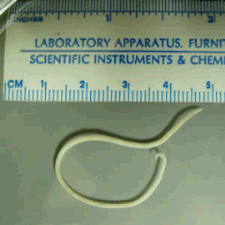
Adult Toxocara cati
(Photocredit: CDC & Alaska State Public Health Library)
|
HOW INFECTION OCCURS:
In cats, there are three ways by which infection with Toxocara canis occurs:
- Consuming infective worm eggs from soil in the environment (generally through normal licking of dirty paws).
- Nursing from an infected mother cat that was herself infected in late pregnancy (most kittens are infected this way).
- Consuming a prey animal (usually rodent) that is carrying developing worms.
Note: dogs cannot be infected with Toxocara cati.
They have their own roundworm: Toxocara canis.
LIFE AS A ROUNDWORM - EGG TO ADULT
|
(YOU CAN SKIP TO TAKE HOME POINTS IF YOU WANT BUT WE THINK WORMS ARE INTERESTING):
Toxocara cati has one of the most amazing life cycle in the animal kingdom. Having an understanding of how roundworms develop from eggs to adults will help ensure that a proper deworming schedule is maintained and that roundworm control plans makes sense. Let us begin at the beginning with the egg.
|
(original graphic by marvistavet.com) |
|
 Roundworm egg Roundworm egg
(Photocredit: CDC Division of Parasitic Diseases) |
|
 embryonated worm egg embryonated worm egg
(Photocredit: CDC Division of Parasitic Diseases) |
|
STEP ONE: THE WORM EGG DEVELOPS AN EMBRYO:
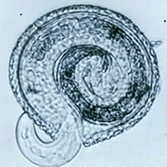
Toxocara eggs are passed in the host’s feces (if a fecal sample is tested, it is possible to detect the eggs and confirm roundworm infection). The baby worm develops in the outdoor world inside its microscopic egg for 2-4 weeks before it becomes able to infect a new host. During those 2-4 weeks, the original feces melts into the local dirt carrying the egg and baby with it. The baby is protected by the egg, which is very tough and able to withstand all sorts of weather changes and temperatures. After the 2-4 week incubation, the egg is basically part of the local dirt and completely invisible but the baby inside is ready for a host and will sit there inside its egg waiting. Eggs can remain infective for months to years.
Note: Fresh feces is not infectious. It takes a month out in the world before the worm embryo is infective.
In this time, visible fecal matter has melted into the soil and it is the soil/dirt that has the infectious eggs.
STEP TWO: THE WORM ENTERS THE CAT:
(Photocredit: Morguefile.com) |
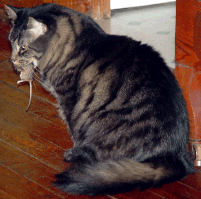
The egg containing the baby (more technically called a “second stage larva”) is picked up orally by an animal licking dirt off itself. This animal is now the worm's host. The egg hatches in the new host’s intestinal tract and the young worm burrows its way out of the intestinal tract to encyst in the host’s other body tissues. If the new host is a cat, the body migration continues. If the new host is a member of another species, such as a rodent, the worm larvae just sit around in the body tissues where they encysted. They don't migrate and don't develop further unless their accidental host comes to be eaten by a cat. Their goal is to get inside a cat one way or the other. These prey animals that carry worm larvae are called, "paratenic" or "transport" hosts. The cat is called the "definitive host." |
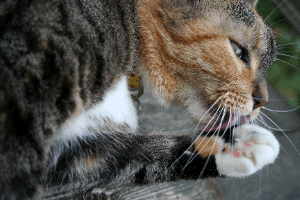
In the process of grooming, a cat
can consume roundworm eggs from soil
(Photocredit: Carolyn Wil via wikimedia commons) |
| STEP THREE: THE YOUNG WORM MIGRATES THROUGH THE CAT'S BODY: At this point, the second stage larva has entered the cat's body and broken out of the intestinal tract. Some larvae simply migrate to the nearby liver and encyst there. Others move to the mammary gland (see later) but the majority will head for the cat's lungs and will have made it there (to the lungs) within three days of entering the cat. Once they get to the lung, they develop into "third stage larvae" and burrow into the small airways ultimately traveling upward towards the host’s throat. A heavy infection can produce a serious pneumonia. When they get to the upper airways, their presence generates coughing. The worms are coughed up into the host’s throat where they are swallowed thus entering the intestinal tract for the second time in their development. |
|
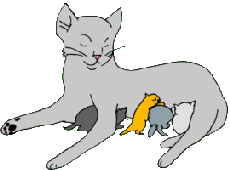
If the host is a nursing mother, second stage larvae can migrate to the mammary gland instead of the lung. Kittens can thus be infected by drinking their mother’s milk. Larvae that had encysted in the liver and gone dormant will re-awaken during the host's pregnancy, continuing their migration just in time to infect the nursing kittens. In this way, a well dewormed mother cat can still find herself infecting her kittens.
|
(original graphic by marvistavet.com)
|
Note: When cats are dewormed, this affects only worms in the intestinal tract.
It does not affect encysted larvae. It is very difficult to prevent
mother to kitten transmission and routine deworming is not adequate.
STEP FOUR: WORMS MATE AND LAY EGGS OF THEIR OWN: The young worms returning to the feline intestinal tract are almost grown up. They are called "fourth stage larvae" and very quickly mature to adulthood and being to mate. Their first eggs can be detected in host feces approximately 4-5 weeks from the time the egg and its baby are first consumed by the host. From here, the worm's life cycle repeats.
WHY IS IT GOOD TO KNOW THE LIFE CYCLE?
There are some important "take home points" from this information:
- Fresh feces is not infectious to cats but dirt could be.
- Cats can get roundworms from cleaning dirt off their fur.
- Cats can get roundworms from hunting.
- Mother cats readily give roundworms to nursing kittens.
- There is a whole body worm migration which means that all the worms in the process of migration must be killed off if the cat is to be "roundworm free." In other words, one deworming treatment is not enough.
HOW DO WE KNOW IF OUR CAT IS INFECTED?
|
You may not know and this is one of the arguments in favor of regular deworming. Regular deworming is especially recommended for cats that hunt and might consume the flesh of hosts carrying worm larvae. Kittens are simply assumed to be infected and automatically dewormed on a regular schedule.
Of course, there are ways to find out if your pet is infected. If a cat or kitten vomits up a worm, there is a good chance this is a roundworm (especially in a kitten). Roundworms are long, white and described as looking like spaghetti. Tapeworms can also be vomited up but these are flat and obviously segmented. If you are not sure what type of worm you are seeing, bring it to your vet’s office for identification.
Fecal testing for worm eggs is a must for kittens and a good idea for adult cats having their annual check up. Obviously, if there are worms present, they must be laying eggs in order to be detected but, by and large, fecal testing is a reliable method of detection.
|
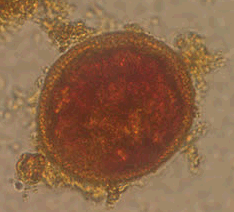
Toxocara egg
(Photocredit: CDC Division of Parasitic Diseases)
|
HOW DO WE GET RID OF ROUNDWORMS?
Numerous deworming products are effective. Some are over the counter and some are prescription. Many flea control and/or heartworm prevention products provide a monthly deworming which is especially helpful in minimizing environmental contamination. Common active ingredients include:
- Pyrantel pamoate (active ingredient in Strongid®, Nemex®, Drontal®, Heartgard® and others)
- Piperazine (active ingredient in many over the counter products)
- Fenbendazole (active ingredient in Panacur®)
- Selamectin (active ingredient in Revolution®)
- Emodepside (active ingredient in Profender®)
- Moxidectin (Active ingredient in Advantage Multi®)
- Eprinomectin (active ingredient in Centragard®)
- Milbemycin oxime (active ingredient in Interceptor®)
There are two important concepts to keep in mind about deworming. Medications essentially anesthetize the worm so that it lets go of its grip on the host intestine and passes with the stool. Once it has been passed, it cannot survive in the environment and dies.
This means that you will likely see the worms when they pass, so be prepared
as they can be quite long and may still be alive and moving when you see them.
The other concept stems from the fact that larvae in migration cannot be killed by most deworming products. After the worms are cleared from the intestine by a deworm treatment, they will be replaced by new worms completing their migration. This means that a second, and sometimes even a third deworming is needed to keep the intestine clear. The follow-up deworming is generally given several weeks following the first deworming to allow for migrating worms to arrive in the intestine where they are vulnerable.
Do not forget your follow-up deworming.
At this time the emodepside product and the eprinomectin product
are the only ones that can attack immature worms still in the process of migration,
as well as the intestinal adults with one treatment.
All other dewormers require repeat deworming.
|
The Companion Animal Parasite Council recommends that
routine deworming of kittens begins at age 2 weeks to prevent hookworm infection
and then the kittens should be placed on a monthly heartworm preventive
that includes protection/deworming against Toxocara cati.
For details on the CAPC roundworm guidelines, visit:
https://capcvet.org/guidelines/ascarid/
|
|
WHAT ABOUT TOXASCARIS LEONINA?
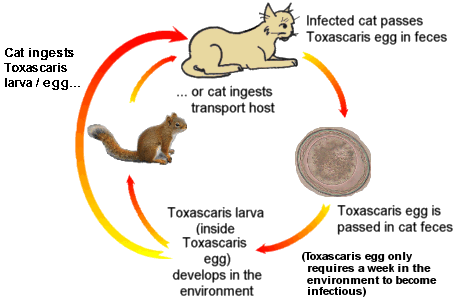
The life cycle of Toxascaris leonina is not nearly as complicated. This parasite does not migrate through the body in the way that Toxocara does. As before, the egg is passed in feces and the baby worm develops inside it. The Toxascaris egg only requires a week out in the world to become infectious. After that, it is ready to be licked by a cat. After the cat consumes the egg and baby, the egg hatches in the cat's intestine and develops into an adult worm over the next 2-3 months. There is no body migration and no arrested development. One the worms are adults, they mate and produce eggs of their own. 
(Photocredit cat: original graphic by marvistavet.com)
(Photocredit squirrel: Morguefile.com)
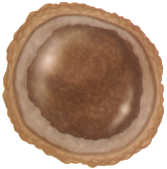
(Photocredit Toxascaris egg: Joel Mills via Wikimedia Commons)
Note: Toxascaris leonina can infect both dogs and cats alike.
As with Toxocara cati diarrhea can result from the presence of Toxascaris leonina and deworming is needed to control symptoms and prevent contagion. Many of the newer deworming products are not labeled for use against Toxascaris leonina, which does not necessarily mean that they do not work but here are the reliable classics that have been used for decades with efficacy:
- Pyrantel pamoate (active ingredient in Strongid®, Nemex®, Drontal®, Heartgard® and others)
- Piperazine (active ingredient in many over the counter products)
- Fenbendazole (active ingredient in Panacur®)
Because Toxocara has a body migration, a sequence of deworming is typically performed so as to get all the larvae that were migrating at the time of the earlier deworming. Because Toxascaris does not migrate, only one deworming should cover it. Of course, a known infection of either worm suggests a contaminated environment which is why the Companion Animal Parasite Council recommends regular deworming for pet dogs and cats.
FOR MORE INFORMATION:
The Companion Animal Parasite Council has put up an educational site for cat owners on parasites including Roundworms:
www.petsandparasites.org/cat-owners/overview
Page last updated: 6/15/2026
| 
 Processing ....